Concept
What Is FLOW4Med?
It is an EU-supported project under Horizon Europe and PRIMA, with a total funding of €2.7 million, bringing together eight partners from five countries. The three-year project will scale and evaluate Nature-based Solutions (NbS) to strengthen water security and ecosystem resilience across three Mediterranean sites in Lebanon, Greece, and Egypt.
Goals and Objectives
The main objective of the FLOW4Med project is to demonstrate the benefits and cost-effectiveness of NbS for water security and ecological resilience. To ensure their longevity, these activities will be tailored to three diverse Mediterranean socio-ecological settings and co-created with local communities through Living Lab structures. The goal is not only to implement the NbS but also to improve their design and operation, establish replication strategies, and increase uptake in Mediterranean contexts, as well as their inclusion in local and national policy recommendations.
Testing Sites
All NbS demonstrators have been piloted and thus proven to be feasible. To scale up the NbS, three demonstration sites across rural, semi-rural, and urban contexts will be developed. However, to achieve relevant and beneficial outcomes, NbS need to be co-designed with local stakeholders.

Egypt
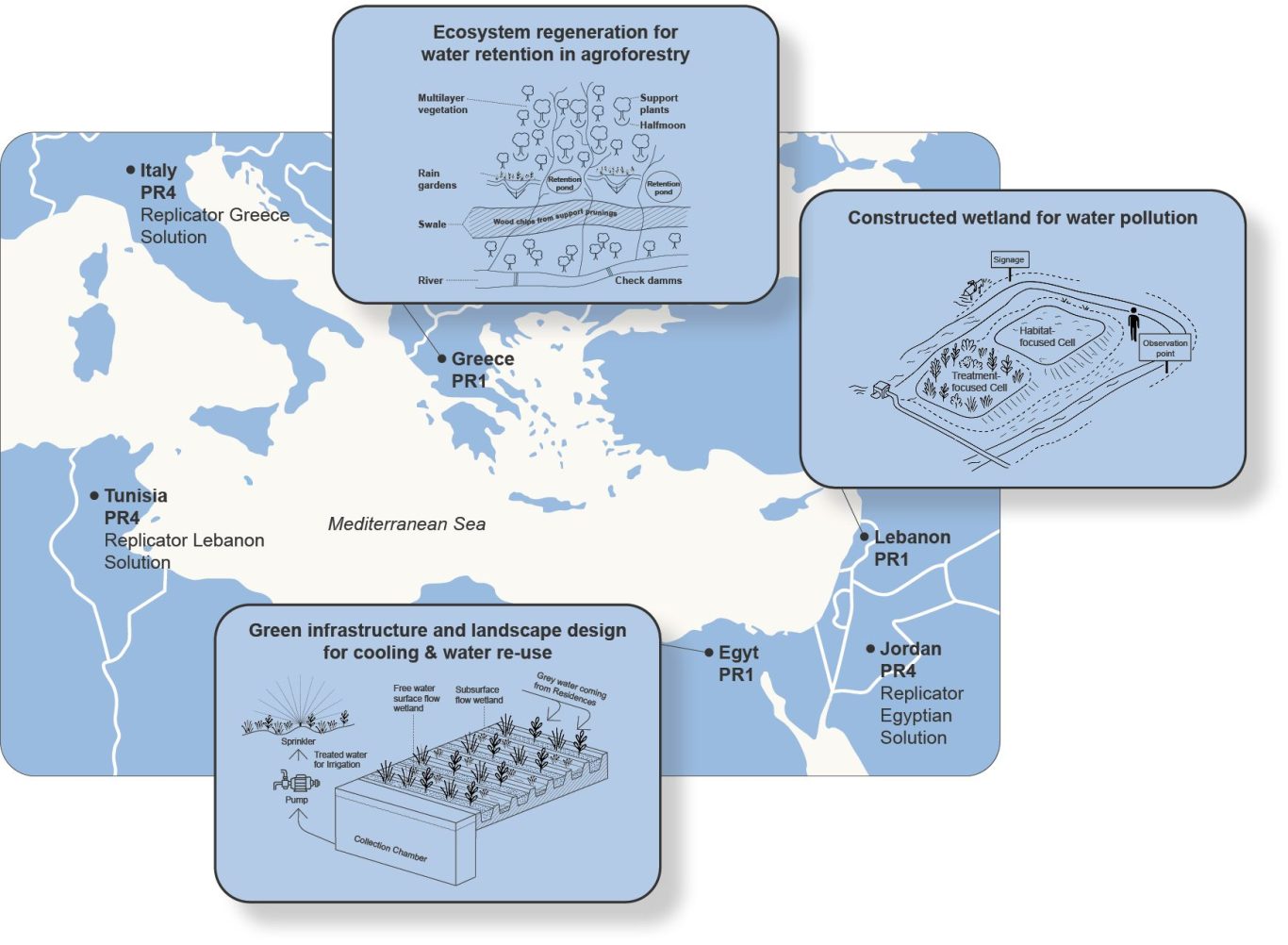
In Cairo, urban green infrastructure, drought-tolerant landscape design and water treatment will be established to mitigate urban heat island effects, improve microclimates, and promote greywater reuse.

Greece
In Crete, ecosystem regeneration techniques such as swales, syntropic planting, and soil enrichment will be applied to enhance water retention and restore resilience.

Lebanon
In Akkar, a constructed wetland will treat municipal wastewater, reducing pollution in the Al Kabir River basin, enabling safe water reuse, which will improve the local socio-economic conditions.
Scaling Strategy
Scaling-up
Optimising NbS design and performance to support policy and system-level integration.
Scaling-out
Focuses on the replication of NbS designs and governance models in similar Mediterranean environments.
Scaling-deep
Targets local stakeholder engagement, fostering long-term ownership and integration of NbS into community practices.
Living Labs
The project uses Living Labs as a real-world tool to co-create, test, and refine solutions with stakeholders. They will serve as platforms for continuous dialogue, adaptive learning, and shared innovation, ensuring that NbS designs are not only technically sound but socially rooted and broadly supported. Living Labs activities will include interactive workshops, co-learning sessions, training programs, and participatory monitoring protocols that directly inform governance and policy recommendations.
Interdisciplinarity and Gender Dimension
FLOW4Med tackles its complex challenges by integrating diverse expertise like engineering, hydrology, agroecology, urban planning, and social sciences. This collaborative model ensures solutions align with local socio-cultural dynamics, fostering impact across the Water-Energy-Food-Ecosystem (WEFE) nexus.
For this reason, the project values interdisciplinarity as well as gender-sensitivity. Women are often central to managing household and community water resources. Yet, they are frequently underrepresented in formal decision-making. Therefore, FLOW4Med ensures equitable participation, for example in workshops, focus groups, and capacity-building sessions. Gender balance is also promoted within our project governance and individual teams.

Challenges of Nature-based Solutions
Although the potential of NbS has been demonstrated in numerous research and pilot projects, their implementation in the Mediterranean remains limited. Key barriers to widespread adoption of NbS in the Mediterranean are:
Knowledge gaps on the long-term benefits of NbS due to fragmented monitoring and evaluation.
Limited awareness of NbS impacts among stakeholders.
Lacking guidelines on designing, implementing, monitoring, and maintaining NbS.
The absence of long-term local governance and business models, and integrated policy support within various policies.
Acknowledgement of EU funding
Funded by the PRIMA Foundation (co-funded by the European Union and the Participating States). Views and opinions expressed are, however, those of the author(s) only and do not necessarily reflect those of the European Union or the PRIMA Foundation. Neither the European Union nor the granting authority can be held responsible for them.
Privacy Policy | Legal Notice | Imprint